20+ Years Expertise 丨 Fast Production 丨 Global Certification丨 Whatsapp +86-17376506696



Procurement planning
Commercial Kitchen Equipment Buying Guide: A Procurement Checklist
Prepare your menu, capacity, layout, utilities and equipment list before requesting a commercial kitchen quote. Includes a practical procurement checklist.
Start here
Before requesting a commercial kitchen equipment quotation, prepare six things: your menu, peak production requirement, kitchen layout, available utilities, equipment list and destination. These details help a manufacturer recommend suitable models and separate standard equipment from work that needs customization.
A product name such as “combi oven” or “commercial refrigerator” starts the conversation, but it does not define a complete purchase. Two machines can look similar while requiring different tray formats, electrical supplies, working space or installation arrangements. This guide shows how to turn a general equipment request into a brief that can be quoted and compared.
1. Define the job each machine must do
Begin with the food and workflow. A bakery preparing several products in separate batches has different needs from a hotel serving one large banquet. List the items each machine will handle, the portion or batch size, the required output during your busiest period, and when the next batch must be ready.
Use peak demand as a planning input rather than relying only on daily totals. A kitchen serving 300 meals throughout a day may have a very different bottleneck from one that must finish 300 portions in a short service window. Avoid converting a seating count directly into an oven size without checking the actual menu and loading arrangement.
- Restaurant or hotel: identify the busiest service window and dishes competing for the same equipment.
- Bakery: record tray dimensions, products per tray and the planned batch schedule.
- Central kitchen: map preparation, cooking, holding, cooling and dispatch as separate steps.
- Distributor: identify the intended customer use, model requirements and destination documentation.
2. Build an equipment list around the workflow
Organize the list by task before selecting individual machines. Include quantities and identify which items are essential for opening day. Mark equipment that must match an existing line, bench height, tray system or storage layout.
| Task | Starting point | Information to include |
|---|---|---|
| Cooking and finishing | Commercial cooking equipment | Menu, peak batches, heating method, working dimensions |
| Baking and dough preparation | Commercial bakery equipment | Product type, tray size, batch schedule, mixing and proofing needs |
| Cold storage and preparation | Commercial refrigeration equipment | Stored products, target temperature, capacity, cabinet format |
| Washing and disinfection | Washing and disinfection equipment | Items per service period, loading format, water and drainage |
| Preparation and processing | Food processing equipment | Ingredient, batch size, required processing task |
| Work surfaces and storage | Commercial kitchen workbenches | Dimensions, placement, material requirements and storage needs |
For oven selection, use our commercial combi oven guide and commercial deck oven guide alongside the corresponding product specifications.
3. Check the site before choosing the configuration
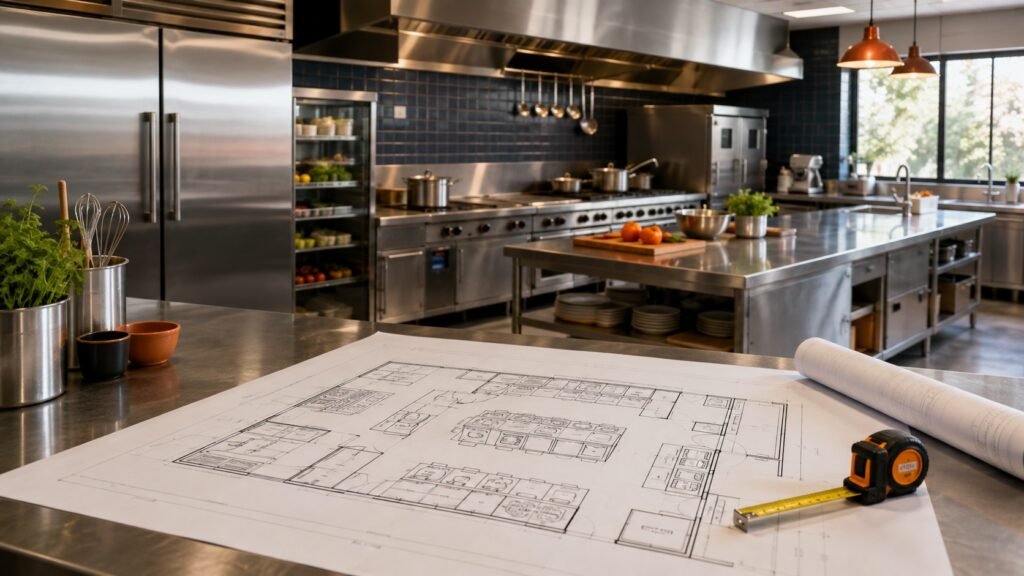
Send a measured layout showing equipment positions, doors, corridors, water points, drains and existing utilities. Record the delivery route as well as the final installation space: an oven that fits the kitchen footprint may still be difficult to move through a doorway or into a lift.
For electrical equipment, state voltage, frequency and phase. For gas equipment, state the gas type and ask for the selected model’s connection requirements. Water quality, drainage, ventilation and service clearances must be checked against the installation information for the actual equipment. Have the people responsible for your site review the proposed configuration before ordering.
A gas-heated machine may still need electricity for controls or other components. “Gas” and “electric” are not sufficient specifications on their own. Do not assume a different plug or nozzle makes an otherwise unsuitable configuration compatible.
4. Separate standard specifications from customization
Keep the standard model, requested changes and confirmed configuration in separate columns. This prevents a quotation for a standard machine from being compared with one that includes different materials, dimensions or controls.
At DONGIC, customization is confirmed by model. Standard stainless steel grades vary by series and component. Full SUS304 construction can be requested; specify the construction scope you need so it can be included in the model review and quotation. A stainless steel appearance alone does not identify the material grade of every component.
Certification also needs a model-level check. Our range includes models with CE, ETL, UL, CSA and NSF certifications, but the coverage varies. Give us your required certification and destination so we can confirm the relevant documentation for the selected equipment.
5. Compare quotations on the same basis
Compare the complete configuration, not just the headline price. Ask each quotation to identify the model, quantity, standard specifications, included accessories, optional work, packing and delivery scope. Keep payment and warranty terms alongside the equipment list rather than assuming they are identical across offers.
| Item | What to confirm |
|---|---|
| Model and capacity | Exact model code, tray or cabinet format, and valid configuration |
| Utilities | Voltage, phase, frequency, gas type and applicable water/drain connections |
| Accessories | Trays, stands, racks, probes or other items included in the quoted scope |
| Custom work | Material scope, dimensions, branding and any confirmed option changes |
| Documentation | Applicable model documents and the destination requirements supplied by the buyer |
| Timing | Production schedule, dispatch arrangement and transport time as separate items |
| After-sales support | Warranty terms, remote assistance, replacement parts and who performs local installation |
6. Send a quotation brief that can be acted on
Copy the following checklist into your inquiry. If something is unknown, mark it as “to confirm” rather than guessing. A drawing, equipment schedule or current product link is usually more useful than a long general description.
Commercial kitchen quotation brief
- Business type and menu:
- Peak production or batch requirement:
- Equipment models or category links:
- Quantity for each item:
- Tray/container dimensions, where relevant:
- Kitchen layout and available equipment space:
- Voltage, frequency, phase and gas type, where relevant:
- Material or customization requirements:
- Required certifications:
- Destination country/port:
- Required delivery date:
- Additional requirements:
DONGIC is a commercial kitchen equipment manufacturer. We respond within two business hours and provide product quotations within half a business day. Commercial kitchen project proposals and quotations take 3–5 business days. Include the relevant model or equipment list so we can prepare an accurate response.
Frequently asked questions
Can I order one piece of equipment instead of a complete kitchen?
Yes. Our standard minimum order is one set. You can start with a specific product inquiry or discuss a complete equipment package through our commercial kitchen project service.
Does the production lead time include shipping?
No. Our standard product production lead time is 10–15 days. Transport time is separate, and the schedule for the selected configuration, quantity and destination should be confirmed in the quotation.
Will DONGIC send an engineer to install the equipment?
We provide 24/7 remote video support for installation guidance and troubleshooting, rather than an on-site service. All products carry a 12-month warranty. Replacement parts can be shipped for repairs, with most parts held in stock. Your local team needs to arrange site installation.
Prepare your equipment quotation
Send your list, layout and destination. We’ll help you confirm the models and configuration for your project.
Send Your Equipment Requirements →